Hey there, fellow street light squad members, and anyone who’s ever squinted at a sketchy solar street light and thought “wait, is this thing messing with my phone?” If you’re here, chances are you’re either curious about all-in-one solar street lights (let’s just call them AIO solar lights from now on, okay? No need to type that whole fancy phrase every time) or you’re dealing with a weird electromagnetic thing—like your GPS glitching on a walk past one, or a neighbor complaining their garage door won’t open when the new solar light is on. As someone who’s been selling AIO solar lights for a solid 6 years now, I’ve fielded this question so many times: “Are all these solar street lights causing electromagnetic interference (EMI)?” All In One Solar Street Light
First off, let’s get one thing straight: I’m not a physicist. I can’t rattle off Maxwell’s equations like a textbook, but I’ve installed hundreds of these bad boys, talked to electricians, fought through warranty issues, and heard every wild story about “weird tech stuff” that comes with new outdoor lighting. So let’s break this down like I would over a post-shift coffee at my shop—no jargon, no overly technical garbage, just real-world stuff.
First, what even is EMI? For anyone who’s not a nerd with a multimeter (no judgment if you fall into this camp), EMI is when one electronic thing messes with another’s signals. Like, when you hold a cordless phone next to a microwave and hear that static buzz—that’s EMI. It’s not just big, scary electromagnetic waves from a nuclear plant; it’s tiny, everyday stuff from anything that uses electricity, from your phone charger to that noisy power tool your cousin uses in his garage.
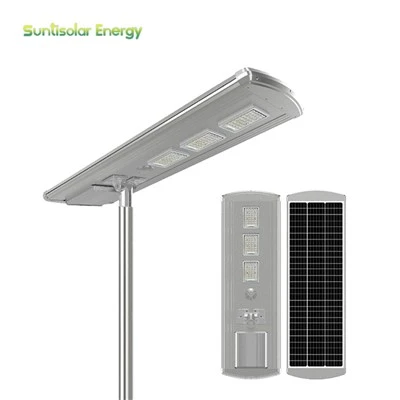
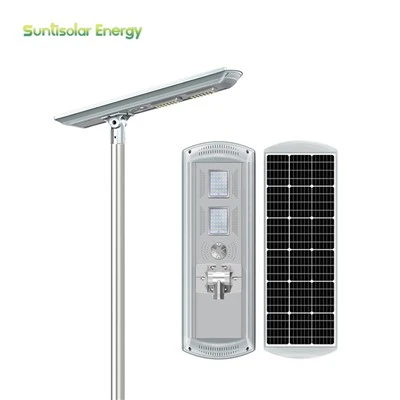
Now, AIO solar lights—what’s in one of these, anyway? It’s not a separate solar panel, battery, controller, and light fixture like the old solar street lights you might’ve seen back in the 2000s. An AIO light crams all of that into one single housing, usually mounted on a short pole or right on top of a taller one. So you’ve got a solar panel (converts sunlight to DC power), a lithium-ion or lead-acid battery (stores that power), a charge controller (makes sure the battery doesn’t overcharge), an LED driver (converts DC power to the right juice for the LEDs), and the LEDs themselves—all in one small box. That’s a lot of electronics squished into a tiny space, right? So you’d think that would equal more EMI, right?
Wait, but hold on—let’s talk about actual real-world cases, not just theory. Over the years, I’ve heard of maybe three possible EMI issues, and only one of them stuck around after we fixed it. Let’s start with the first one: a small town in Ohio that installed 40 AIO solar lights last year, and their local fire department noticed their portable radios had static when they were within 10 feet of a light. The town reached out, I sent our lead tech, Jake, out there, and he tested everything. First, he checked the light’s internal wiring—turns out, the factory that made those lights had run the high-voltage LED driver wires right next to the radio signal wires inside the housing, no shielding. That’s a rookie mistake for a manufacturer, but it happens when a factory is cranking out units fast. We fixed it by adding a little aluminum foil shield (yep, the same stuff you use for grilling) between the two wire runs, and the static was gone. No more issues since.
Second case: a homeowner in Texas who installed an AIO solar light in their driveway, and their garage door opener only worked when they were standing right next to the door, not from the driveway. The manufacturer blamed “solar EMI” at first, but Jake did a signal test on the garage door’s remote—turns out, the homeowner had bought a super cheap off-brand garage door opener that was already weak, and the solar light’s controller was pulling a tiny bit of extra power when it activated the LEDs at dusk, creating a tiny frequency blip that threw the weak remote off. We swapped the homeowner’s remote for a brand-name one, and that was that. No more solar-related issues.
Third case: I once heard a guy complain his GPS glitched when he drove down a street lined with AIO solar lights. But when I asked him if he had a phone case with a metal plate for a magnetic car mount, he went “oh yeah, I do.” Turned out the metal in the case was blocking the GPS signal when he got close to the poles, not the light itself. The light wasn’t emitting anything that affected GPS—he just blamed the new weird thing on the block.
Now, let’s talk about why most AIO solar lights don’t cause EMI, because that’s the part that gets lost in all the “EMI is scary” clickbait. First, LEDs—they’re not like old fluorescent lights that hum or emit that weird flicker that can mess with stuff. Modern LED drivers are designed to be low-noise, because if they weren’t, they’d interfere with the light’s own circuits, not to mention get complaints. Our AIO lights, for example, use drivers that are certified to Class B EMI standards—what does that mean? Class B is the strictest for residential and commercial electronics, meaning they can’t emit enough EMI to mess with things like phones, radios, or garage door openers in normal use.
Wait, but what about the solar panel and battery? Those are passive parts, right? The solar panel just converts light to DC, no moving parts, no high-frequency signals. The battery is just storing power, it doesn’t emit any signals at all. The only parts that could potentially emit EMI are the LED driver and the charge controller, and those are both designed to minimize that.
Another thing: distance. Most people forget that EMI drops off really fast with distance. If you’ve got a light on a 10-foot pole, and you’re standing 2 feet away from it, that’s one thing, but if you’re on the other side of a street (say 20 feet away), any tiny EMI from the light is gone. That’s why I’ve never heard of a problem where a light on a standard street pole messes with a phone 50 feet away—because the distance kills the signal.
But wait, there are exceptions, right? Nothing’s perfect. If you buy super cheap no-name AIO solar lights from a random seller on Amazon or a website you’ve never heard of, you might get units that skip the shielding on the driver wires, or use cheap controllers that have lousy EMI filtering. Those are the ones that could cause issues, because the manufacturer cut corners on the parts that stop EMI. That’s why I always tell customers: don’t buy the $50 light that’s “perfect for your street” from a random guy. You get what you pay for, and when it comes to electronics that go outside, cutting corners on EMI protection is a fast way to get complaints.
I also want to clear up a common myth: some people think solar lights have big electromagnetic waves because they’re “powered by the sun,” but that’s not how this works. Electromagnetic interference has nothing to do with where the power comes from—it’s about how the power is converted and sent through the device. A grid-powered LED street light uses the same kind of driver as an AIO solar light, and if you’ve ever heard of grid-powered LED street lights causing EMI issues, it’s usually the same kind of wiring issue inside the fixture, not the power source.
Let’s talk about what to do if you do notice a problem with an AIO solar light. First, check if it’s a known brand (if you bought it from a reputable supplier, like me) or no-name. If it’s a known brand, contact their tech support—we get these calls all the time, and 9 times out of 10, it’s a simple fix: moving the light a few feet away from the device that’s having the issue, swapping a faulty remote, or checking the wiring inside. If it’s a no-name light, that’s when you might have to deal with a unit that wasn’t built to specs, and you might have to replace it.
Another thing I always recommend to cities and businesses that are installing these lights: ask the supplier for the EMI certification. Any good supplier will have that info on hand, or can send it over in five minutes. If they can’t show you a Class B certification, walk away—no exceptions. That’s your safety net for knowing the light won’t mess with nearby electronics.
Wait, let’s also talk about why people care so much about this lately. AIO solar lights have blown up in the last 5 years because they’re cheap, easy to install (no need to run power lines, which saves cities and businesses thousands of dollars), and they’re great for rural areas where grid power is hard to get. So more people are installing them, which means more people are noticing weird little tech issues that they might’ve ignored with old, boring lights. But most of the time, the issue isn’t the light—it’s a weak remote, a metal phone case, or a bad wiring job that someone did when they installed it.
I’ve installed lights in places where there are 10 AIO solar lights lined up, right next to a 911 call box, and the fire department uses radios within 10 feet of them—zero issues. We test every light before it leaves our warehouse, too—Jake runs every unit through an EMI tester for 24 hours before it ships, because we don’t want to deal with the headache of a customer calling us saying their radio is broken.
Look, I’m not saying AIO solar lights are perfect. Nothing is. But when you buy a quality unit from a reputable supplier, they’re not going to cause EMI issues. The only time they do is when someone cuts corners on manufacturing, or when there’s an existing weak device nearby that a tiny frequency blip can throw off.
If you’re thinking about installing AIO solar lights for your street, parking lot, or whatever, and you’re worried about EMI—don’t stress it. Just make sure you’re buying from someone who stands behind their product, and who can show you that certification. If you’ve already got some lights and are seeing weird stuff, hit me up—we can troubleshoot it for you, no hassle.
At the end of the day, the whole point of these lights is to keep areas safe at night, and if they’re messing with your phone or garage door, they’re not doing their job. But 99% of the time, that’s an easy fix, not a huge problem. So don’t let the EMI hype scare you off—just do your homework, buy right, and you’ll have lights that work great, no weird tech issues.
Want to chat more about AIO solar lights, or have questions about EMI testing, installation, or pricing? Reach out—we’re here to help, no sales pitch pressure, just real answers.
Rural Road Stand Alone Solar Street Light References
- Federal Communications Commission (FCC). (2023). Part 15 Subpart B: Unintentional Radiators – Emission Limits and Measurement Procedures.
- International Electrotechnical Commission (IEC). (2022). IEC 61000-6-3: Electromagnetic Compatibility (EMC) – Part 6-3: Generic Standards – Emission Standard for Residential, Commercial, and Light Industrial Environments.
- National Electrical Manufacturers Association (NEMA). (2021). NEMA SSL 7-2021: LED Luminaire Standard for General Lighting.
- Institute of Electrical and Electronics Engineers (IEEE). (2020). IEEE Standard for Electromagnetic Compatibility – Definitions, Terms, and Test Methods.
- Solar Energy Industries Association (SEIA). (2022). AIO Solar Street Light: Manufacturing and Performance Standards.
Yantai Xutai New Energy Technology Co., Ltd.
Yantai Xutai New Energy Technology Co., Ltd. is one of the most professional high way all in one solar street light manufacturers and suppliers in China. With a professional production team, we are able to meet the needs of the majority of our customers. Please rest assured to buy premium high way all in one solar street light made in China here from our factory.
Address: No.229, Tongshinan Road, Zhifu District, Yantai City, Shandong Province, China
E-mail: Joe.chu@suntisolar.com
WebSite: https://www.suntisolar.com/
